Diamond knowledge
Lab-grown vs natural diamonds: the differences, the drawbacks, and how to check a GIA or IGI report
Are lab-grown diamonds real diamonds? This guide compares price, hardness, fire and clarity with natural diamonds, when a lab-grown stone can be the better buy, and how to read and verify a GIA or IGI report.
The 30-second version
Lab-grown diamonds are real diamonds. Their chemical, physical and optical properties are essentially the same as natural diamonds. The difference is where and how they grew.
You cannot tell them apart by eye, by phone, or with a diamond tester. A professional gem laboratory or precision instruments are what can do that reliably.
Moissanite and cubic zirconia (CZ) are not diamonds. They are simulants.
Hardness and fire are the same. The real differences are price, origin and resale. For the same specification, a lab-grown diamond is usually much less expensive.
On the market, natural diamonds are most often sold with a GIA report, and lab-grown diamonds most often with an IGI report.
Whichever laboratory it is, look the report number up on the laboratory’s own website, and match it to the laser inscription on the girdle.
Two diamonds sit under the same lamp. Same brightness, same transparency. One is natural, the other is lab-grown. Can you tell?
Honestly, we cannot either. It is not a matter of eyesight. Even a trained gemmologist needs instruments. This article is here to settle it once: is a lab-grown diamond a real diamond? What are the advantages and the drawbacks? What is the difference between GIA and IGI on a report? And the practical part — how to check a report number yourself.
Are lab-grown diamonds real? Three things that can look like a diamond
Yes. A lab-grown diamond is a real diamond. GIA, the Gemological Institute of America, says laboratory-grown diamonds and natural diamonds have essentially the same chemical, physical and optical properties. Both are crystals of carbon atoms arranged in the cubic system.
What you do need to watch for are simulants. They only look the part. The material is different.
| Natural diamond | Lab-grown diamond | Simulants (moissanite, cubic zirconia / CZ, glass and similar) | |
|---|---|---|---|
| Is it a diamond? | Yes | Yes | No |
| Composition | Carbon | Carbon | Moissanite is silicon carbide; CZ is zirconium dioxide |
| How it forms | Naturally, deep in the Earth | Grown in a laboratory by HPHT (high pressure, high temperature) or CVD (chemical vapour deposition) | Other manufactured materials |
| Chemical, physical and optical properties | — | Essentially the same as a natural diamond | Different |
| Can you tell by eye? | Cannot be separated from lab-grown by eye | Cannot be separated from natural by eye | A professional can separate them by optical and physical features |
| How identity is confirmed | A professional gem laboratory or precision instruments | A professional gem laboratory or precision instruments | Standard gemmological testing |
*Table compiled from public GIA material.*
Where do natural diamonds come from?
GIA notes that most natural diamonds formed about 150 to 200 kilometres underground, under high heat and pressure, roughly 1 billion to 3.5 billion years ago, and were later carried closer to the surface by volcanic activity.
How is a lab-grown diamond made?
A lab-grown diamond is grown under controlled conditions. There are two main methods:
- HPHT (high pressure, high temperature): recreates underground heat and pressure so carbon crystallises as diamond.
- CVD (chemical vapour deposition): in a vacuum chamber, carbon atoms from a carbon-bearing gas settle layer by layer onto a diamond seed.
Some lab-grown diamonds are treated after growth to improve colour.
Why can’t an eye, a phone or a diamond tester separate them?
Because the composition and the appearance are essentially the same. GIA says traditional gemmological observation and older “diamond testers” cannot separate natural from laboratory-grown diamonds. What can is a laboratory’s spectroscopy, and precision instruments that can see growth features.
Two things to remember:
- A diamond tester answers “is this a diamond?”, not “natural or lab-grown?” Some older thermal testers can even read moissanite as diamond, because the two conduct heat in a similar way.
- If someone demonstrates with a small instrument on the spot, you can ask directly: “Can this instrument tell natural from lab-grown?”
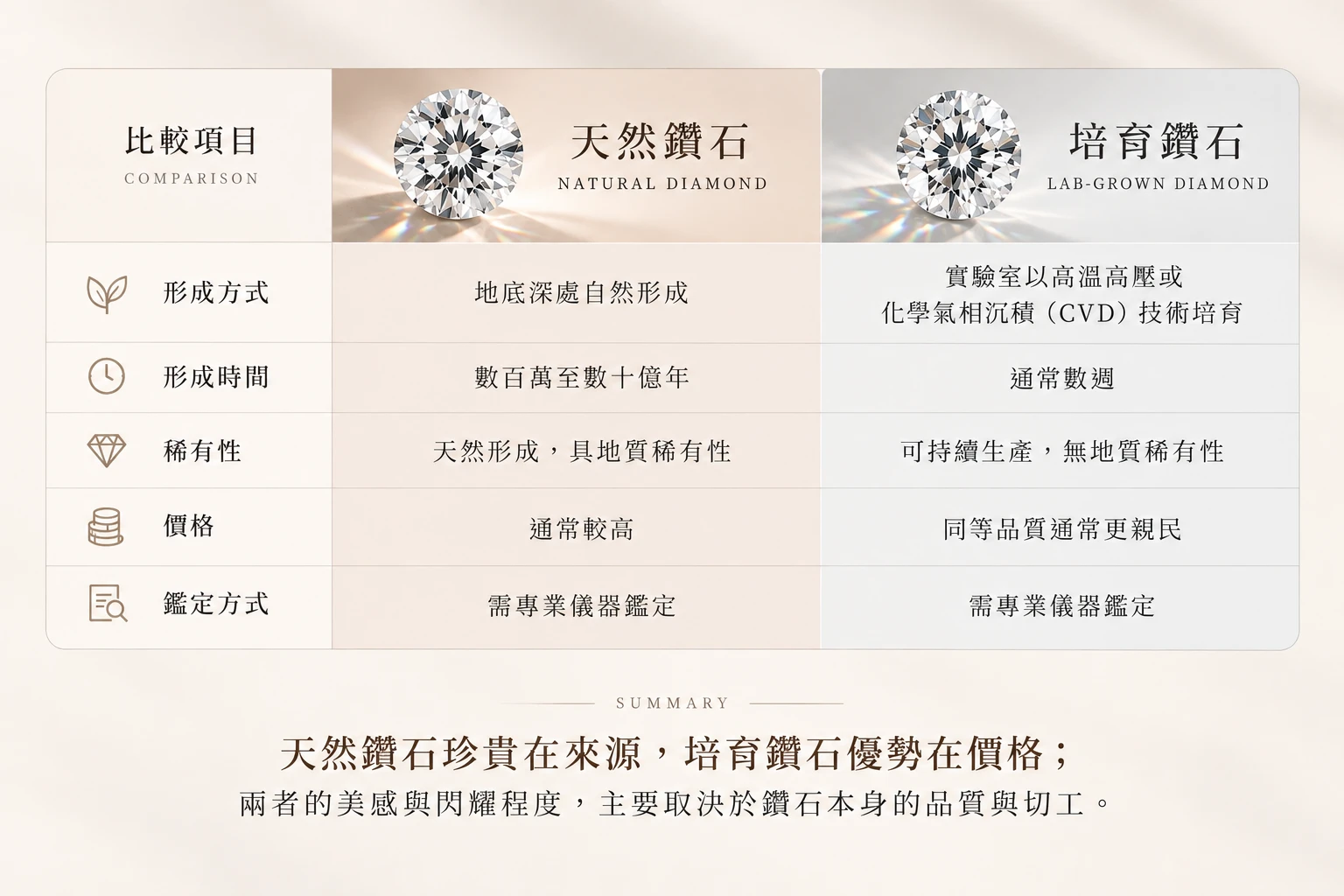
Lab-grown vs natural: price, hardness, fire and clarity
If both are diamonds, where do they actually differ? These are the questions we hear most often:
| Natural diamond | Lab-grown diamond | |
|---|---|---|
| Price | Usually much higher for the same specification | Usually much lower for the same specification |
| Resale | A more established second-hand market, though resale is still generally below the retail price you paid | A limited second-hand market. Not a sensible choice if you are buying to store value or to invest |
| Hardness | Mohs 10 | Mohs 10, the same |
| Fire and brightness | The same optical properties. Sparkle depends mainly on cut | The same optical properties. Sparkle depends mainly on cut |
| Inclusions and clarity | Natural inclusions left from formation underground | HPHT may show metallic flux inclusions. CVD may show growth lines or dark pinpoint inclusions. On the same budget, a higher clarity grade is often within reach |
| Colour | The full D-to-Z range exists, and nearer to colourless is rarer | The market clusters toward higher colour grades. Some stones are treated after growth to improve colour |
| Origin | Formed over about 1 billion to 3.5 billion years of geological time (GIA) | Grown in a laboratory, often in a matter of weeks, and traceable to a producer |
In one sentence: on the hand, the light and the durability are not the difference. The difference is price, origin, and what the stone means to you.
When is a lab-grown diamond the better buy, and when a natural one?
A lab-grown diamond may suit you if
- The budget is limited and you want a larger carat weight. The same budget usually buys a larger lab-grown stone.
- You want a higher clarity or colour grade. The same budget more often reaches a near-colourless stone with fewer inclusions.
- You will wear it every day and you are not worried about knocks. Hardness is the same, so daily wear is no heavier a burden.
- You want a fashion piece or something to stack. You may want several pieces to rotate, or to try a current design.
A natural diamond may suit you if
- Rarity and a stone that came from the Earth matter to you. The long geological story is not something that can be repeated.
- It is for a proposal, an anniversary, or something to pass on. You want a piece with that kind of meaning.
- A long-term second-hand market matters to you. Natural diamonds have more established resale routes. That still does not make them an investment.
- You are buying for someone who cares that it is natural. Ask first. Sometimes the origin is part of the gift.
What is the difference between GIA and IGI?
On the market, natural diamonds are most often accompanied by a GIA report, and lab-grown diamonds by an IGI report. That is a common market habit, not a rule. Both laboratories grade natural and laboratory-grown diamonds.
A diamond report usually includes:
- Report number: unique to that report, and what you type into the laboratory’s website.
- The 4Cs: carat weight, colour, clarity and cut. A GIA natural-diamond report and an IGI report list the grades.
- Measurements: length, width and depth in millimetres.
- Polish, symmetry and fluorescence.
- Laser inscription: a number on the girdle. On an IGI laboratory-grown diamond the number starts with “LG”.
- Growth method (on an IGI laboratory-grown report): CVD or HPHT.
How do you know the report is genuine? Enter the report number at GIA Report Check or IGI Verify Your Report, and confirm that the website matches the paper in your hand. The steps are below.
Want to know what colour, clarity, cut and carat are actually describing? Read Diamond 4Cs for first-time buyers.
How to check a diamond report in about three minutes
A paper report can be photocopied, altered, or paired with a different stone. The record that counts is the one in the laboratory’s own database. The lookup is free and does not need an account.
Step 1. Find the report number. It is usually at the top of the report or beside the barcode. An IGI laboratory-grown number starts with “LG”.
Step 2. Type the number into the laboratory’s site.
- GIA: GIA Report Check
- IGI: IGI Verify Your Report
A QR code on the report is convenient, but it is only a link. The safer habit is to type the laboratory’s address and the report number yourself, rather than open a link someone sent you.
Step 3. Check each line. Carat weight, measurements in millimetres, colour grade, clarity and shape on the website should match the paper report and the product page.
Step 4. Check the laser inscription. The number on the girdle, the outer edge of the stone, is not visible to the naked eye. Ask the seller to show it under a loupe or a microscope, and confirm it matches the report.
If the number is not found, or the details do not match: pause the payment. It may be a typing error, or it may be a problem with the report. Ask the seller to explain, or contact the laboratory directly.
Small accent stones set beside the centre stone are not usually given their own report. It is the centre stone that commonly has one. What documents come with a piece follows the product page or the seller’s description. RIUNE’s Before you buy says the same: diamond type (natural or lab-grown), metal purity and any certification follow the product page. If something is not marked, email and ask.
Buying a diamond you will wear every day: a checklist
- Identity. Natural or lab-grown? Is that written clearly on the product page or the receipt?
- Specification. Carat, colour and clarity if they are stated, plus width, height and other measurements.
- Documents. Is there a report? Which laboratory, and what is the report number? Have you looked it up?
- If it is lab-grown. What growth method does the report state, CVD or HPHT?
- Metal. 10K, 18K or platinum? Will the setting and its height suit the way you use your hands?
- Size. Have you measured the finger? Which finger will you wear it on? Each finger is a different size. See the size guide.
- After-sales. What are the terms for returns, resizing and care?
Start with a diamond you can keep on
RIUNE wants the first real piece of jewellery you buy to be one you can wear every day. If you like the clean look of one centre stone, these are useful places to start comparing:
- 18K Gold · Radiant Dream · Solitaire Ring: a 10-point style (0.12 ct) and a 20-point style (0.21 ct). The product page marks them as natural diamonds, F/VS. A straightforward first solitaire.
- 18K Gold · Dream Stage · Solitaire Ring: natural diamond 0.2 ct (F/VS), with the eye on a single point of light.
- If you wear necklaces more often, the 18K · 30-Point Six-Prong · Solitaire Diamond Necklace comes in 18K gold and 18K white gold, with a natural diamond around 0.3 ct (F/VS; it varies by style).
*The specification, price and documents for each piece follow that product page.*
Common questions
Are lab-grown diamonds real, or fake?
They are real diamonds. GIA says laboratory-grown and natural diamonds have essentially the same chemical, physical and optical properties. The difference is how they formed. “Fake diamond” is the right name for a simulant such as moissanite or CZ.
What is the drawback of a lab-grown diamond?
The one people mention most is resale. The second-hand market is limited, so a lab-grown diamond is not a good way to store value or to invest. It also does not have the rarity of a natural diamond formed over geological time. If what you care about is the light and the durability on the hand, those two are not different.
How is a lab-grown diamond different from moissanite?
A lab-grown diamond is diamond, which is carbon. Moissanite is silicon carbide, a different material, and a diamond simulant. Some older diamond testers cannot separate moissanite. That needs a more specific test.
Can a diamond tester tell natural from lab-grown?
No. A tester is mainly answering “is this a diamond?”. It does not answer natural or lab-grown. Confirming origin needs a professional laboratory or precision instruments.
Which is better, a GIA report or an IGI report?
Both are well-known independent laboratories. On the market, natural diamonds more often come with GIA and lab-grown diamonds more often with IGI. More important than the logo is that the report number can be found on the laboratory’s website and that it matches the stone.
Do lab-grown diamonds sparkle less?
No. The optical properties are the same. Sparkle depends mainly on the cut.
How do I check that a diamond report is genuine?
Use GIA Report Check or IGI Verify Your Report, compare the online record with the paper report and the product page, and ask to see the laser inscription on the girdle.
The page only says “real diamond”. Can I order?
Ask first: natural or lab-grown? What is the specification? Which documents come with it? Not every small piece is sold with the same kind of report, but the seller should be able to say so clearly.
The diamond that stays with you
Natural or lab-grown, GIA or IGI, the point is the same: you should know what you are choosing, and then wear it without a second guess.
- All diamond styles: rings and necklaces
- Still deciding which finger: Which finger to wear a ring on
- A question about diamond type, specification or documents for a particular piece: contact us. We reply from the product information.
*Materials, specifications, prices and after-sales terms follow each product page and the policies the brand has confirmed.*
Sources
- GIA, Laboratory-Grown Diamonds / How Do Diamonds Form (gia.edu)
- GIA Report Check: https://www.gia.edu/report-check-landing
- IGI Verify Your Report: https://www.igi.org/Verify-Your-Report/