Diamond knowledge
What are the diamond 4Cs? Carat, colour, clarity and cut charts for a first diamond
The 4Cs are carat, colour, clarity and cut. Four charts explain what each one is looking at, with a carat-to-diameter guide, how to read “F/VS”, and which C to look after first when the budget is limited.
In 30 seconds
- The 4Cs are four ways GIA looks at a diamond: carat (weight), colour, clarity and cut.
- Carat is weight, not size. 1 carat = 0.2 grams = 100 points.
- Colour runs from D (colourless) to Z. Clarity runs from FL (Flawless) to I3, 11 grades in all.
- Cut is what most affects sparkle. On a limited budget, look after the cut first.
- “F/VS” on a product page means colour F (colourless) and clarity VS (very slightly included).
The first question people ask is “how many carats?”. Two diamonds of the same weight can still be different: one bright, one dull; one white, one a little warm. That difference lives in the 4Cs. Four tables, and the letters on a product page or a report start to mean something.
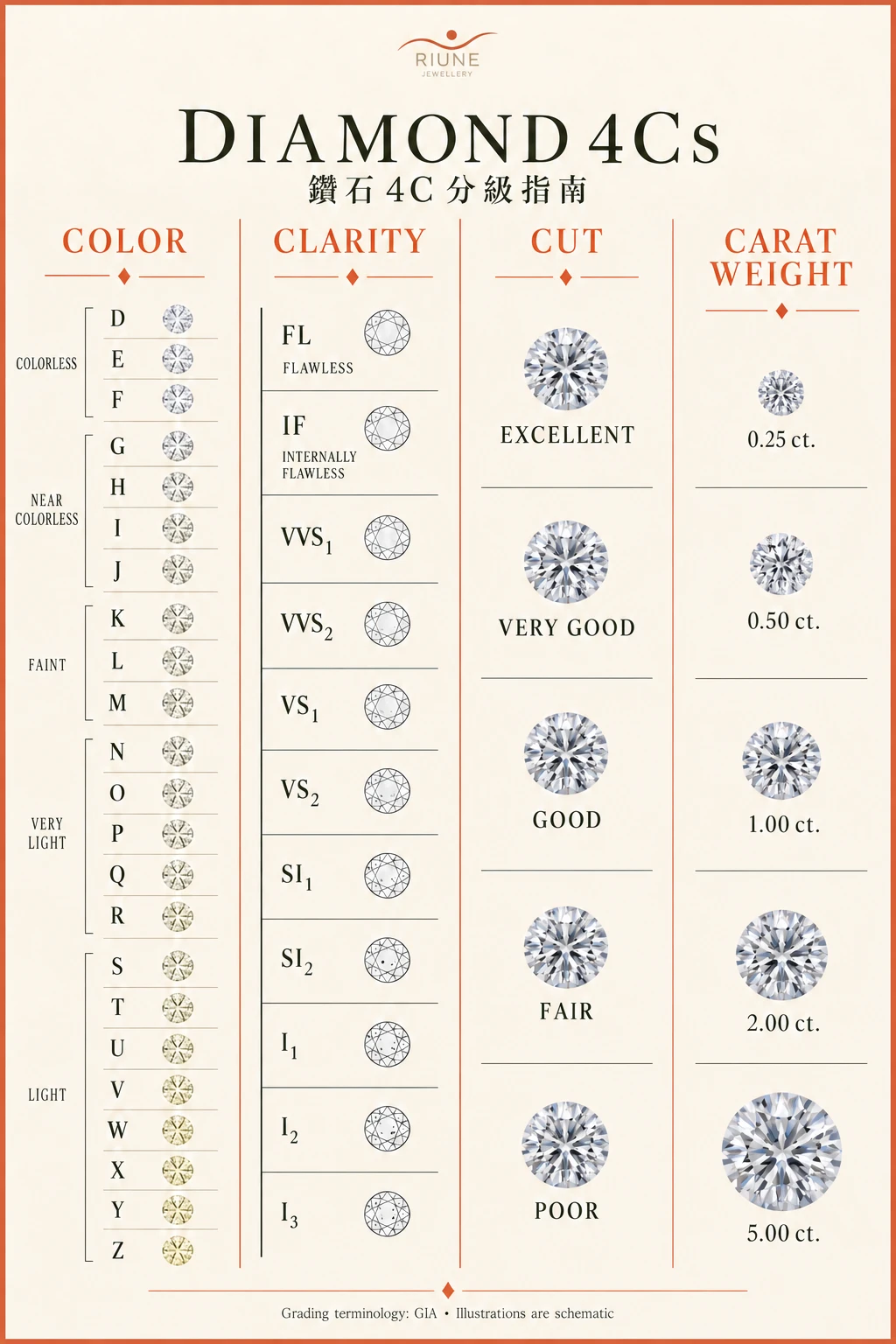
The 4Cs on one table
| 4C | What it is looking at | The range | Ask this before you buy |
|---|---|---|---|
| Carat | Weight | 1 carat = 0.2 grams = 100 points | What is the diameter, or the length and width, in mm? |
| Colour | How much yellow, brown or grey tint | D (colourless) to Z | Were they compared under the same light? |
| Clarity | Natural features inside and on the surface | FL to I3, 11 grades | Is the feature in the centre or at the edge? |
| Cut | How the finished stone handles light | Excellent to Poor, for a standard round brilliant | Does this shape even receive a cut grade? |
*Compiled from GIA’s 4C material. This article follows the ordinary D-to-Z scale used for natural diamonds. Fancy-colour diamonds are graded separately.*
Carat: how large is it? Weight and diameter
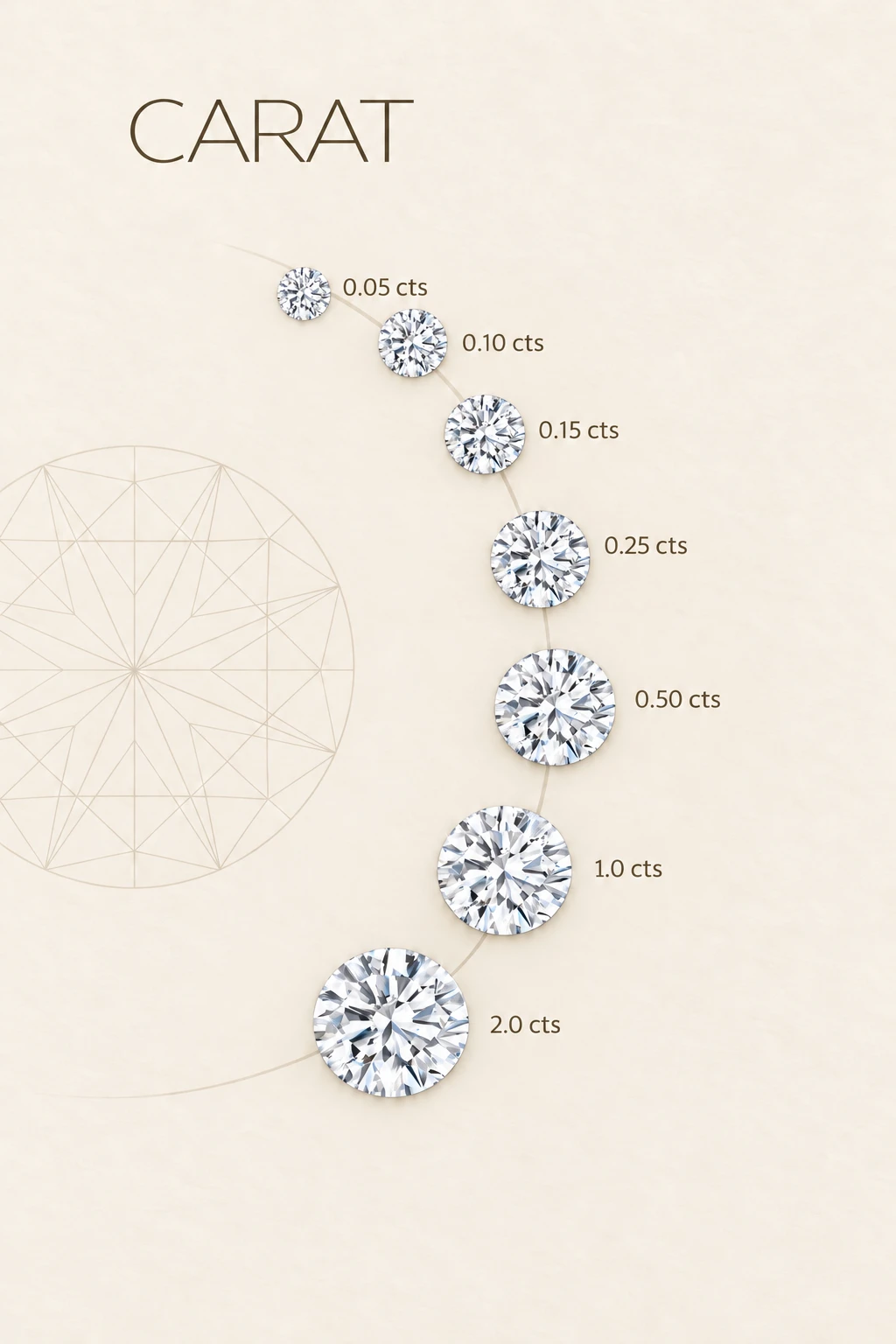
Carat is weight, not size. 1 carat is 0.2 grams, divided into 100 points, so 0.3 carat is “30 points”. A “0.2 ct” on a product page is 0.2 carat, not 0.2 grams. Those two figures differ by a factor of five.
At the same weight, a stone cut a little deeper can look smaller from the front. The diameters below are common references for a standard round brilliant.
| Carat (points) | Approximate diameter | A RIUNE reference |
|---|---|---|
| 0.05 ct (5 points) | About 2.4–2.5 mm | 18K Gold · 5-Point Six-Prong · Solitaire Diamond Necklace (0.05 ct, F/VS) |
| 0.10 ct (10 points) | About 3.0 mm | The 10-point style of the 18K Gold · Radiant Dream · Solitaire Ring (0.12 ct, F/VS) |
| 0.20 ct (20 points) | About 3.8 mm | 18K Gold · Dream Stage · Solitaire Ring (0.2 ct, F/VS) |
| 0.30 ct (30 points) | About 4.3 mm | 18K · 30-Point Six-Prong · Solitaire Diamond Necklace (about 0.3 ct, F/VS) |
| 0.50 ct (50 points) | About 5.2 mm | A 50-point proposal-ring style (quoted from the specification) |
| 1.00 ct (100 points) | About 6.5 mm | — |
*Diameters are general references. The actual size changes with the cut proportions. Use the millimetres on the product page or the report.*
Try-on check: compare size at the distance you normally look at your hand. Do not judge it from a magnified photo.
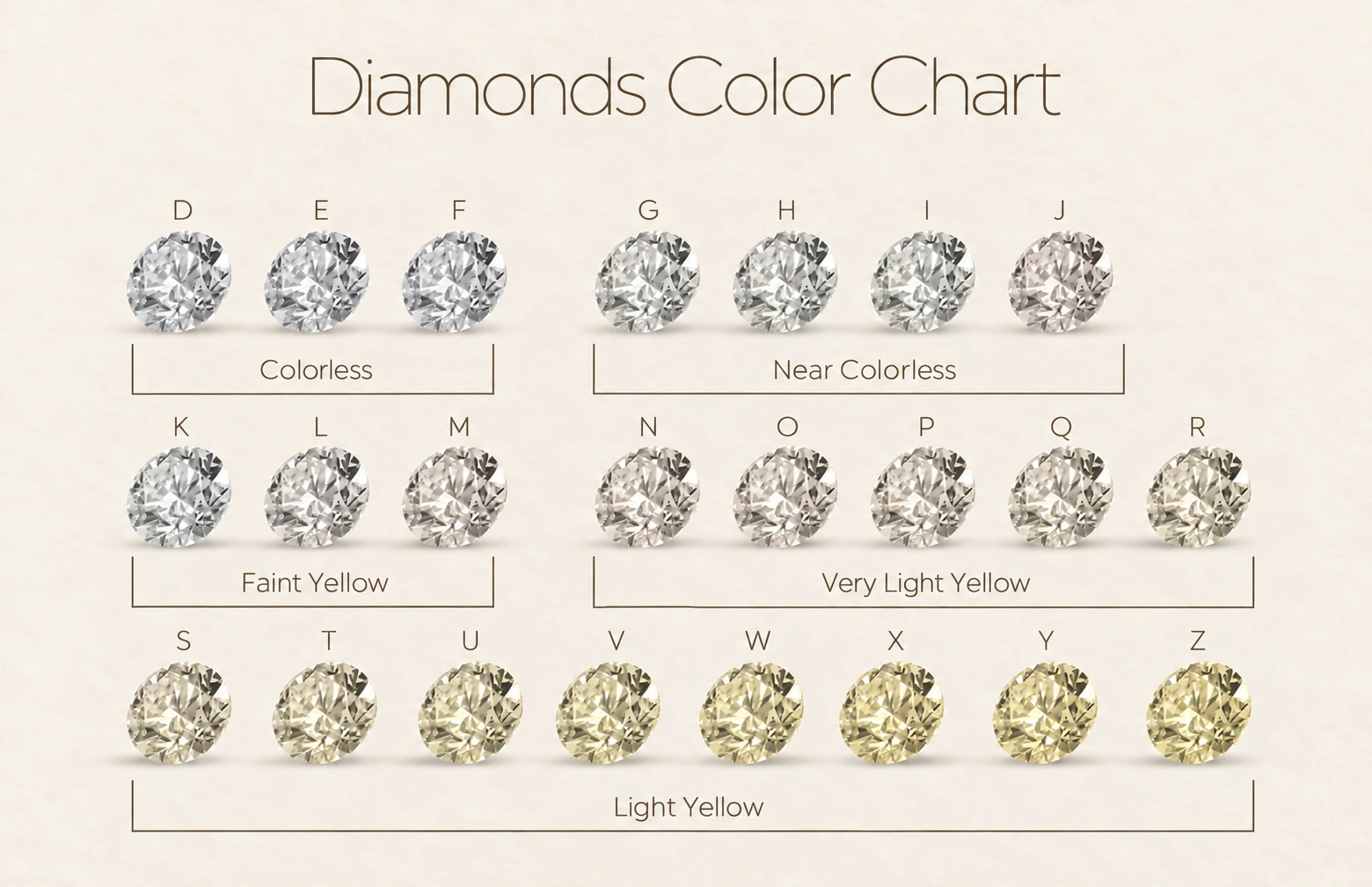
Colour: D to Z
Colour is how much light yellow, brown or grey the diamond shows. GIA’s scale starts at D. Further along, the tint is easier to see.
| Grade | Group | How it reads |
|---|---|---|
| D, E, F | Colourless | The whitest and most transparent |
| G, H, I, J | Near colourless | Once it is set, most people find the tint hard to see |
| K, L, M | Faint yellow | A warm tone if you look closely |
| N to R | Very light yellow | The tint is visible |
| S to Z | Light yellow | The tint is obvious |
A colour grade only counts when the stone is compared with master stones under controlled light. Shop lighting, window light and a phone’s white balance can all change how the same diamond looks, so do not compare colour from photographs.
The setting changes it too. In 18K yellow gold, a warm mount can make the diamond look slightly warmer. In white K gold, the whole ring looks whiter.
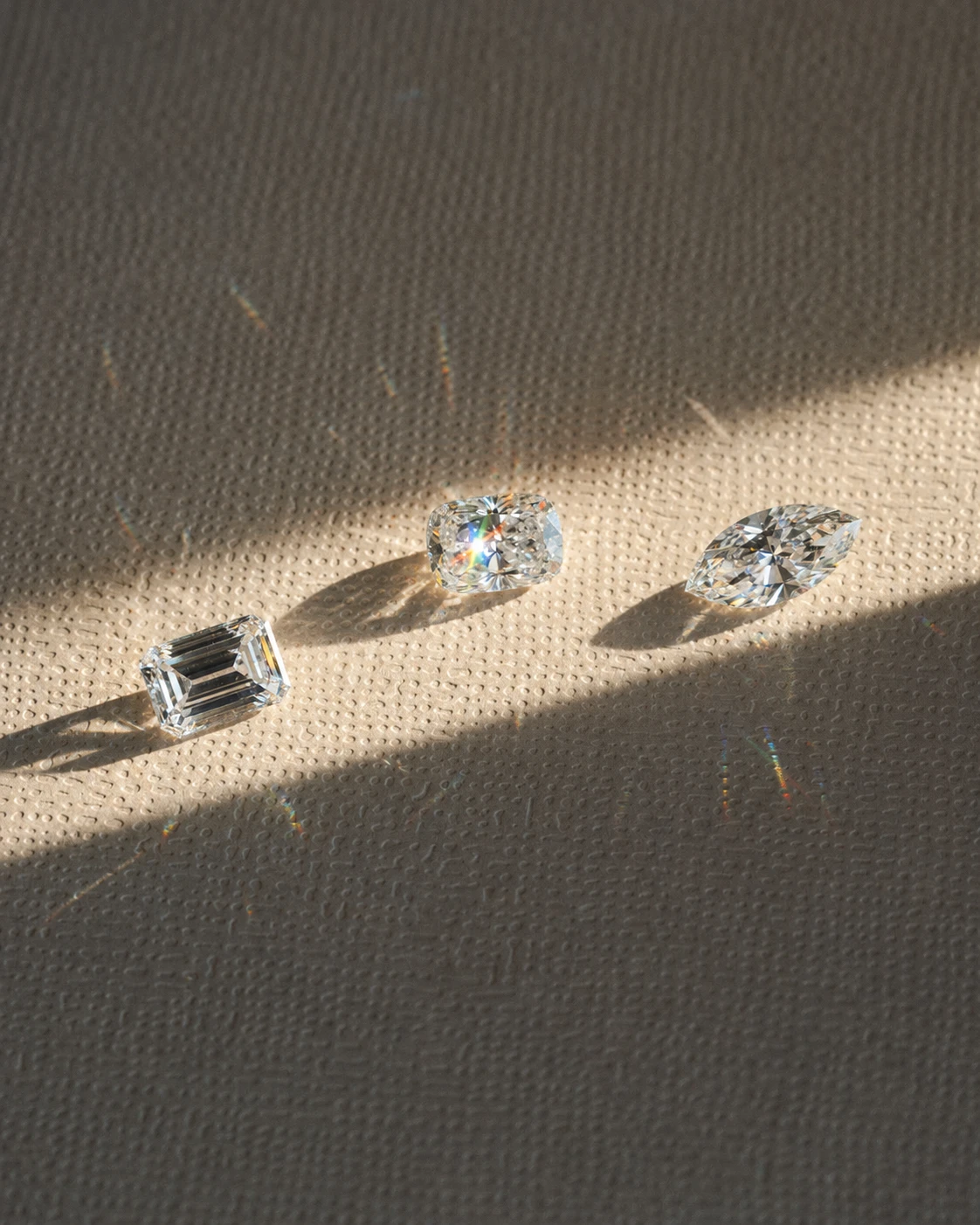
Clarity: FL to I3
Clarity is the natural features inside the diamond and on its surface. At 10× magnification, GIA uses six groups and 11 grades.
| Grade | Name | At 10× |
|---|---|---|
| FL | Flawless | No inclusions or blemishes seen |
| IF | Internally Flawless | No inclusions seen |
| VVS1, VVS2 | Very, Very Slightly Included | Extremely small, difficult to see |
| VS1, VS2 | Very Slightly Included | Minor, from difficult to moderately easy to see |
| SI1, SI2 | Slightly Included | Noticeable, easy to see |
| I1, I2, I3 | Included | Obvious, and they may affect transparency and brightness |
Those descriptions use 10× magnification. A VS feature is “difficult to moderately easy” to see only when magnified. At a normal distance, on the hand, it is usually not visible. Two SI stones can also look different if one feature sits in the centre and the other is at the edge. Ask where the main feature is.
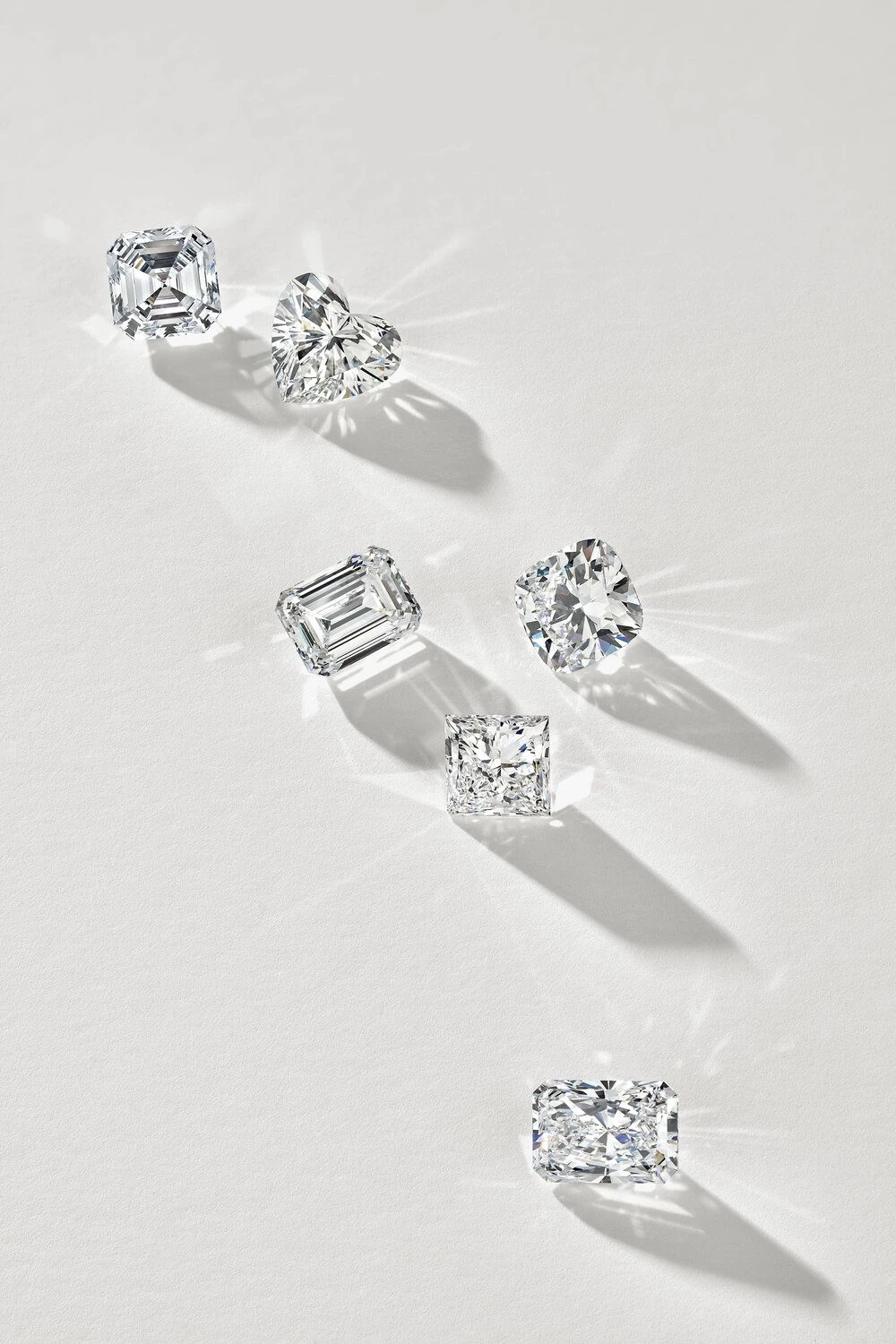
Cut: why it does the most for sparkle
Cut is how light enters the finished stone and comes back out. GIA looks at three kinds of light.
- Brightness: white light reflected back.
- Fire: light split into colour.
- Scintillation: the flash of light and dark as the stone moves.
| Cut grade | What it means |
|---|---|
| Excellent | The top grade, and the best return of light |
| Very Good | Strong, and not far from Excellent |
| Good | Sound, with a little less brightness |
| Fair | The light performance is clearly weaker |
| Poor | A lot of light is lost, and the stone looks dark |
This overall cut grade applies only to standard round brilliants on the D-to-Z scale. Ovals, pears, marquises and other fancy shapes do not receive an overall GIA cut grade. For those, the light you see in the stone is the better guide.
Try-on check: turn your wrist gently. See whether light and dark alternate evenly, or whether a whole area stays dark.
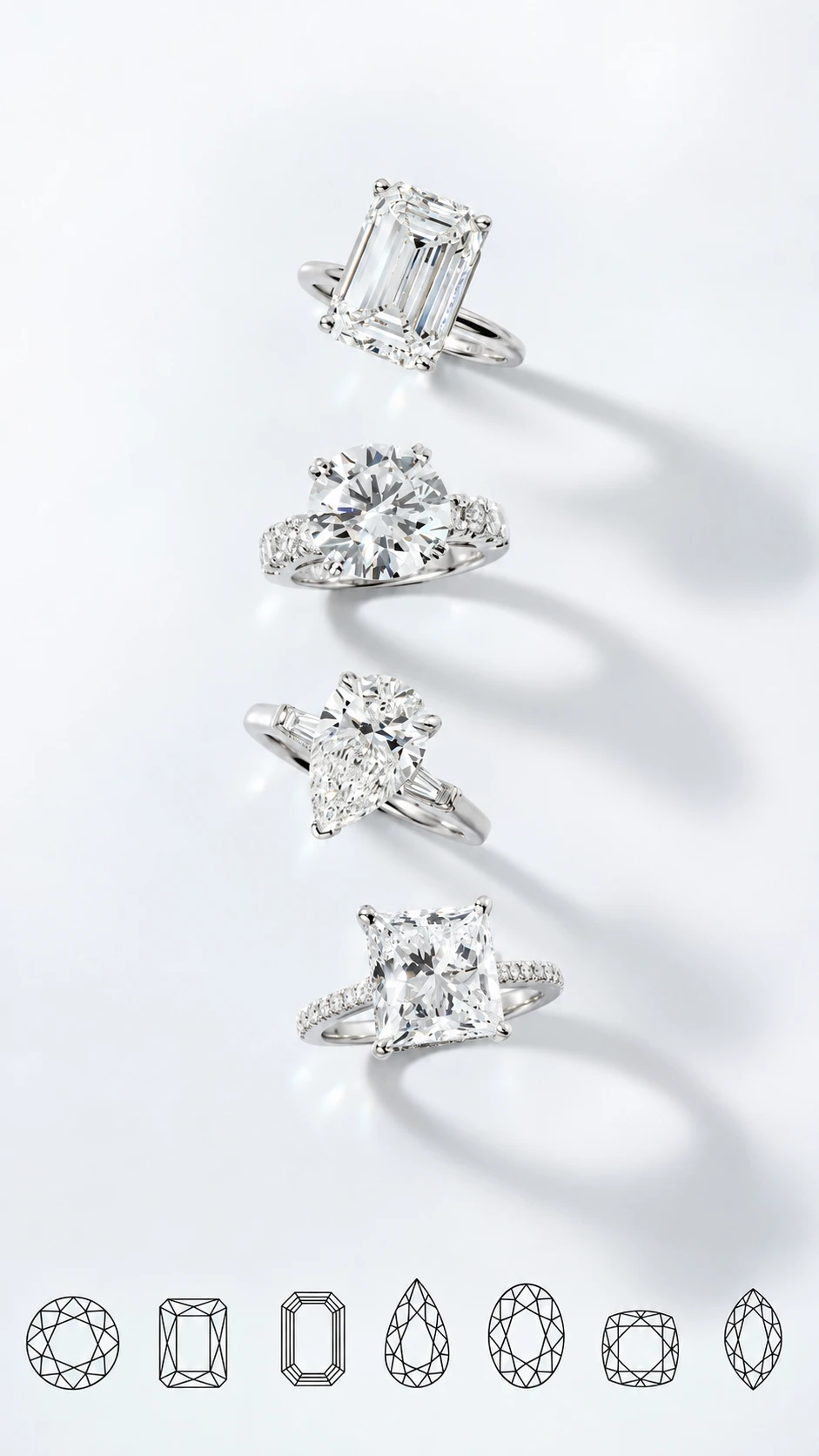
What does “F/VS” mean?
Colour and clarity written together. F is the colour, in the colourless group (D–F). VS is the clarity: very slightly included. For a small diamond worn every day, F/VS is already a white, clean combination.
Several RIUNE solitaires are marked as natural diamonds, F/VS.
- 18K Gold · Radiant Dream · Solitaire Ring: a 10-point style at 0.12 ct, and a 20-point style at 0.21 ct.
- 18K Gold · Dream Stage · Solitaire Ring: 0.2 ct.
- 18K rose gold Heartfelt Simplicity 10-point bezel-set solitaire diamond bracelet: 0.11 ct.
Diamond type, specification and documents follow the product page. If something is not marked, email and ask.
On a limited budget, which C comes first?
A common order is this.
- Cut first. Cut decides the sparkle. For a round brilliant, look at Excellent or Very Good before the others.
- Then colour. Once a diamond is set in everyday jewellery, most people find G–J, the near-colourless range, hard to tell apart. If you want the whitest, look at D–F.
- Clarity only needs to be “not visible while you wear it”. At a normal distance a VS feature is usually invisible. You do not have to chase VVS or FL.
- Carat last. Once the first three are where you want them, let the budget set the size.
An example. Xiao An wants a solitaire for the commute, and the budget is tight. She puts carat, diameter, colour and clarity for each candidate in one table, tries them under the same lamp, and chooses a 10-point F/VS. She would rather see light every time she turns her wrist than have a larger stone that looks dull.
Common questions
How large is a 1 carat diamond?
A standard round brilliant is about 6.5 mm. The actual size changes with the cut proportions.
Does a higher clarity grade mean more sparkle?
No. Clarity describes inclusions. Sparkle comes mainly from the cut.
Does one carat always look twice as big as half a carat?
No. Carat is weight. 1 carat is about 6.5 mm and 0.5 carat is about 5.2 mm. Face-up, that is not twice the size.
Does a small diamond need a certificate?
Accent stones set into a piece are not usually given their own report. It is the centre stone that commonly has one. What documents come with a piece follows the product page or the seller. How to read a report, and how to look the number up, is in Lab-grown vs natural diamonds.
Is the top grade in every C the best choice?
The top grade is also the highest price. Look after the cut first, then choose colour and clarity at the point where you cannot see a difference while wearing the piece. The budget that remains can go to the size or the design you care about.
Take the 4Cs with you
- Solitaire and diamond rings: rings
- Solitaire necklaces: necklaces
- Still deciding which finger, or how to measure: Which finger to wear a ring on
To check the diamond specification or the documents for a particular piece, write to [email protected]. We reply from the product information. Within 6 months of purchase, inspection or repair for non-user damage is free.