Materials explained
What is K gold? How 10K, 14K and 18K differ in colour, hallmarks and everyday wear
K gold is gold mixed with other metals. A higher number means more gold. This guide compares 24K, 18K, 14K and 10K on content, hallmarks and daily wear, then explains white gold, rose gold, 18KGP and resale.
In 30 seconds
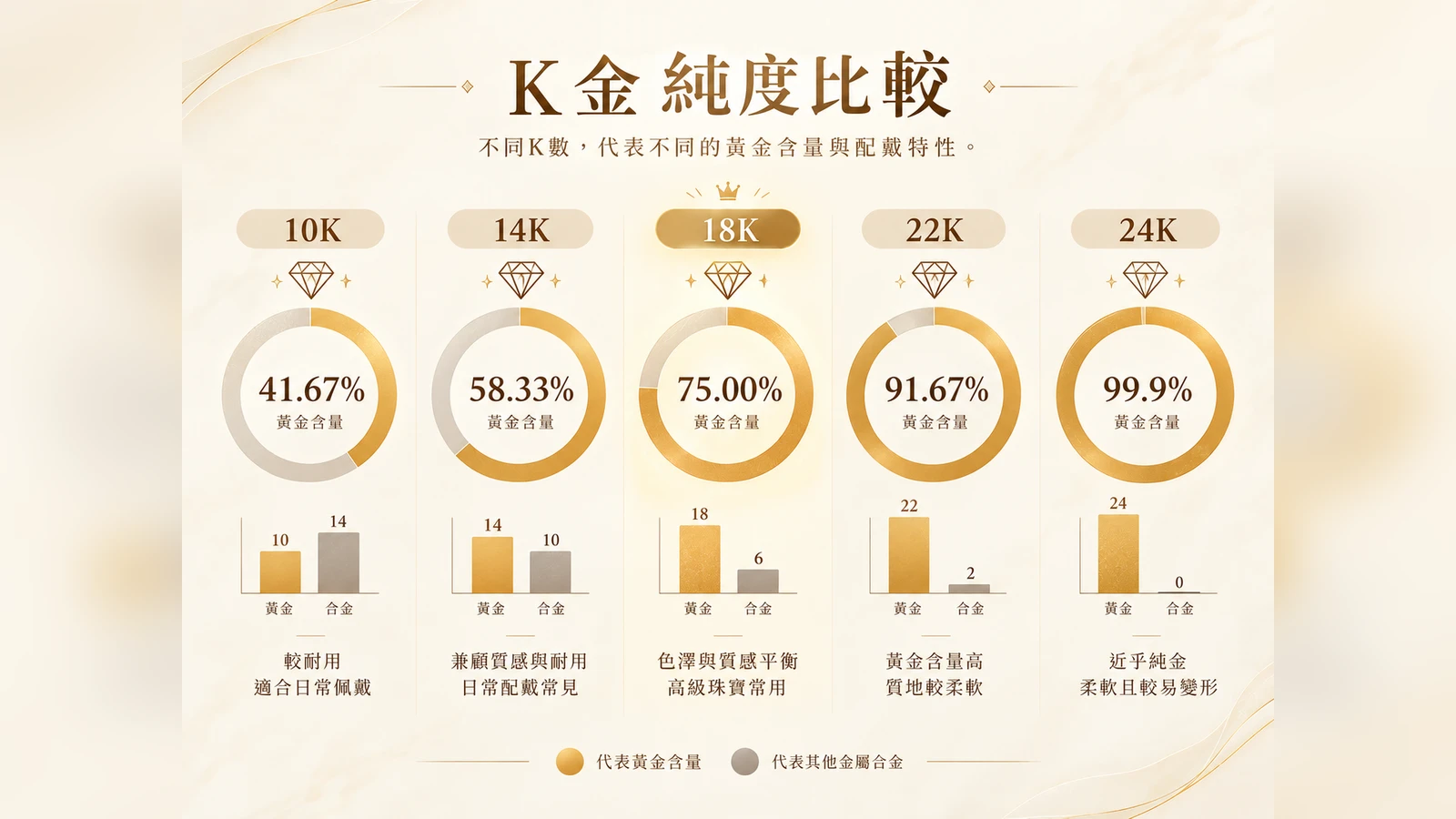
- K gold is an alloy of gold and other metals, such as silver, copper or palladium. The number uses 24 parts as the whole.
- 18K is 75% gold (hallmark 750), 14K is 58.3% (hallmark 585), and 10K is 41.7% (hallmark 417).
- Pure gold (24K) is too soft. It scratches and bends. 14K and 18K are hardened by the other metals, so they are more practical for every day.
- Yellow, white and rose can all be 18K. The difference is the recipe of the other 25%.
- 18KGP is gold plate. It is not 18K gold.
10K, 14K and 18K sit next to very different prices. The number is simply how much of the metal is gold. Once that is clear, you can choose by how you wear jewellery, instead of paying more only because the K is higher, or buying a metal that will not survive daily wear.
What is K gold, and why isn’t jewellery made of pure gold?
K gold is gold mixed with other metals. “K” is short for karat, and the scale has 24 parts. 18K means 18 of those 24 parts are gold. The other 6 parts, 25%, are silver, copper and similar metals.
Pure gold (24K) has the fullest colour, and it is also the softest. A fine ring or a diamond setting in pure gold scratches, dents, and does not hold a prong well. Everyday jewellery is usually 18K or 14K: the added metals make it harder, so it can be worn and can be worked into a finer line.
10K, 14K and 18K on one table
| 24K (pure gold) | 18K | 14K | 10K | |
|---|---|---|---|---|
| Gold content | About 99.9% | 75% | 58.3% | 41.7% |
| A hallmark you may see | 999 | 750 or 18K | 585 or 14K | 417 or 10K |
| Colour | The fullest gold | Close to the colour of gold | A little paler than 18K | The palest gold |
| Hardness | Softest. Scratches and dents easily | Suitable for daily wear | Suitable for daily wear | The highest share of other metals, so it is harder |
| Care | — | Needs polishing now and then | Hardly needs special polishing | — |
| Skin reactions | — | Not likely | Possible | Highest share of other metals. Ask about the alloy if your skin is sensitive |
*Gold content and hallmarks follow the World Gold Council and GIA. The notes on daily wear, care and skin reactions follow GIA’s comparison of 14K and 18K.*
The legal minimum also differs by country. The World Gold Council notes that 10K is the legal minimum in the United States, while the United Kingdom, France and some other countries use 9K.
Yellow, white and rose: where the colour comes from
At 18K the gold content is always 75%. The colour comes from the other 25%.
| Colour | How it is made | What to watch |
|---|---|---|
| Yellow K gold | Gold with silver, copper and similar metals, keeping a gold colour | Closest to the traditional colour of gold |
| Rose gold | A higher share of copper, which gives a pink tone | Ask first if you are sensitive to copper |
| White K gold | Gold with white metals such as palladium or nickel, usually finished with rhodium | Rhodium wears and needs replating. Ask about the alloy if you are sensitive to nickel |
Is “white gold” the same as platinum? No. In Taiwan, “white gold” usually means white K gold, which is still a gold alloy. Platinum (Pt) is a different precious metal. RIUNE’s Blooming Meadow · Engagement Ring and Together · Engagement Ring can be made in 18K gold, 18K rose gold, 18K white gold or platinum.
To see one design in three colours, compare the 18K · Modern Sparkle · Diamond Line Ring: 18K gold, 18K white gold and 18K rose gold.
Should you choose 10K, 14K or 18K?
A first everyday piece, and you want a full gold colour: 18K. The gold content is high and the colour is close to gold itself. GIA also lists 18K among materials suitable for daily wear. Most RIUNE rings, necklaces and bracelets are 18K, including the 18K Gold · Dream Stage · Solitaire Ring.
Work that involves lifting, a lot of knocks, or as little polishing as possible: compare 14K. 14K hardly needs special polishing. The chance of a skin reaction is a little higher than with 18K.
An ear cuff or another small piece, to try a new style: 10K is also a choice. RIUNE’s ear cuffs are 10K gold, including the 10K Gold · Bright Diamond Gold Ball · Ear Cuff and the 10K Gold · V-Shaped Diamond · Ear Cuff (natural diamond 0.09 ct).
What 18K gives you, and what it asks in return
- It is 75% gold, with a full colour. The 750 hallmark is easy to check. GIA marks the chance of a skin reaction to 18K as “not likely”. Yellow, white and rose can all be made in 18K.
- It is a little softer than 14K and needs polishing now and then. Fine marks from daily wear are normal.
Four checks before you buy K gold
- See whether it is K gold or gold plate. “18K gold” on a page is not the same as “18KGP” or “plated with 18K gold”.
- Find the hallmark when it arrives. Look inside the band or near the clasp for 750, 585 or a similar mark.
- If your skin is sensitive, ask about the alloy. Especially for white K gold and rose gold: what is in the alloy, and is there plating?
- Ask about after-sales. Polishing, replating, resizing and repair. At RIUNE, inspection or repair for non-user damage is free within 6 months of purchase. User damage, resizing and replating are quoted separately.
Common questions
Which is better, 14K or 18K?
If you want a fuller gold colour and a lower chance of a skin reaction, choose 18K. If you are hard on jewellery and want less maintenance, compare 14K.
Is 10K real gold?
Yes. 10K is 41.7% gold. It is a real gold alloy, with less gold than 14K or 18K.
What is 18KGP?
GP is short for gold plated. 18KGP is a layer of 18K gold over another metal. The body is not K gold, and the layer wears with friction.
Does K gold fade?
Gold itself is stable and does not rust. The surface of K gold can look dull from sweat, lotion or chemicals. A clean, soft cloth is enough for a gentle wipe. When the rhodium on white K gold wears, replating restores the white brightness.
Is 18K gold worth money? Can it be recycled?
K gold contains real gold, so it has a scrap value. Recycling is usually based on the gold content, at the gold price at the time. Design, craft and the stones are generally not included in that price. Buy jewellery because you like it and will wear it, not as an investment.
Does 18K guarantee that you will not react to it?
No. GIA marks the chance of a reaction to 18K as “not likely”, but it still depends on the alloy and on your skin. If you notice redness, itching or discomfort, stop wearing it and see a doctor if you need to.
Once the number makes sense, choose a piece you can keep on
- 18K rings: rings
- 10K ear cuffs and 18K earrings: earrings
- Care after you have worn it for a while: Jewellery care
- A first piece, and you are not sure where to start: What is light jewellery?
- A diamond, and you want to read the specification first: What are the diamond 4Cs?
Questions about the alloy or the plating of a particular piece can go to [email protected], or through the contact page.