Materials explained
What is an Akoya pearl? How it differs from a freshwater pearl in size, lustre and what to look for
Akoya is a saltwater cultured pearl with a sharp, mirror-like lustre. One table compares Akoya, freshwater and South Sea pearls, then lustre, surface and size, using real 3–8 mm pieces to show what suits an ordinary day.
In 30 seconds
- An Akoya pearl is a saltwater cultured pearl. The name comes from the Japanese Akoya oyster, and the main sources are Japan, Vietnam and China.
- Akoya pearls are often 6–9 mm, white with a rose overtone, and the lustre is sharp, like a mirror. Freshwater pearls are often 6–12 mm, with more choice in colour and shape.
- Look at lustre first, then the surface, then the size.
- Shop grades such as A, AA and AAA are each seller’s own label. There is no single world standard.
- Pearls dislike perfume, hairspray and acids. They go on last and come off first.
A lot of people ask only “is it saltwater?” and never ask how large the pearl is, or whether the lustre is clear. Those two things decide how it looks on you. This guide separates Akoya from freshwater, then how to choose a first pearl.
What is an Akoya pearl?
An Akoya pearl is grown in salt water by the Akoya oyster, Pinctada fucata. A small bead and a piece of mantle tissue are placed in the oyster. The oyster then lays down nacre, layer by layer, around the bead. The more even and the thicker that nacre, the softer and brighter the lustre usually is.
“Cultured” does not mean “fake”. A cultured pearl grows nacre inside a mollusc. A person only starts the process. An imitation pearl is glass, plastic or another material. They are different things.
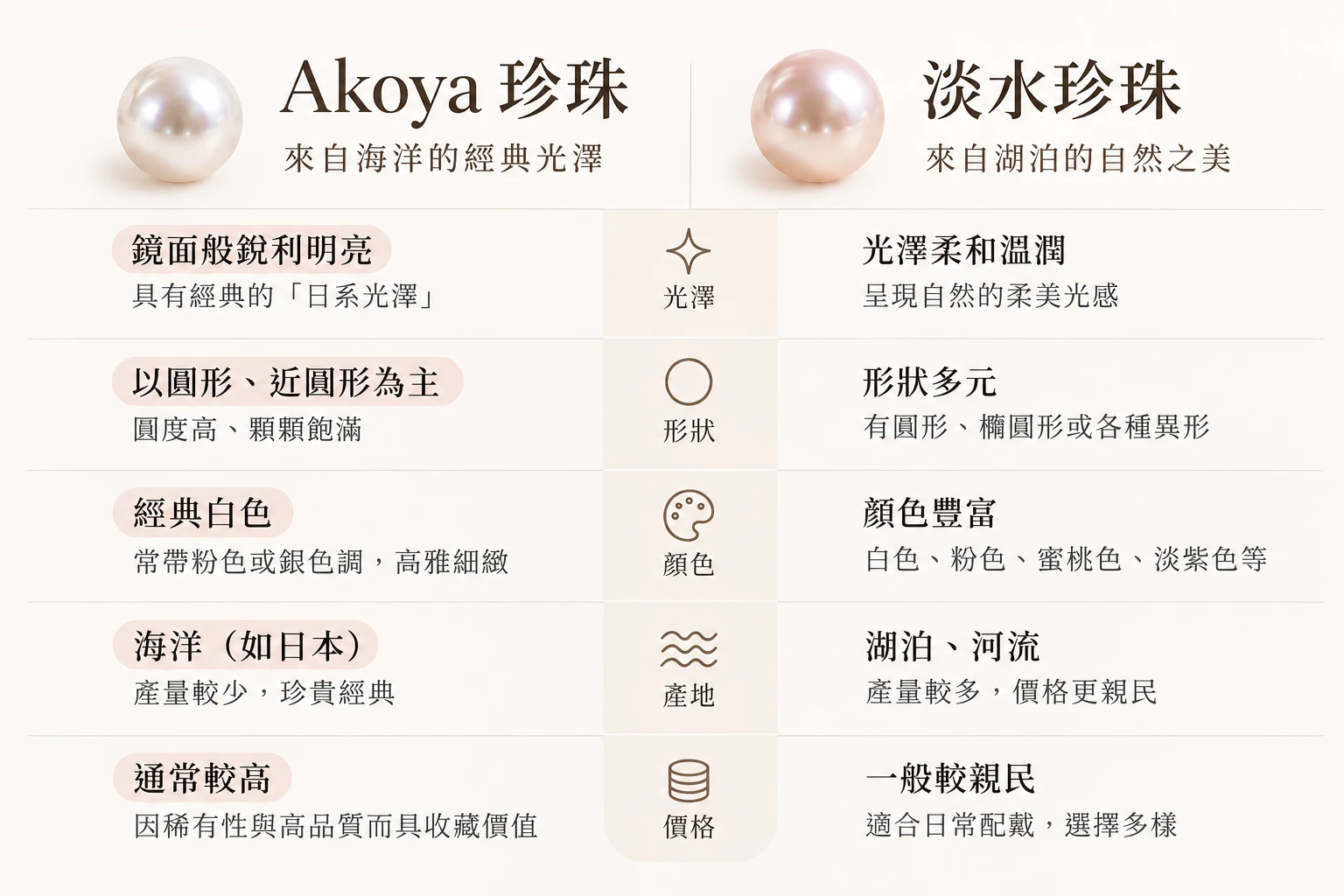
Akoya, freshwater and South Sea, on one table
| Akoya | Freshwater | South Sea | |
|---|---|---|---|
| Where it is grown | Salt water, mainly Japan, Vietnam and China | Rivers, lakes and ponds, mainly China | Salt water, mainly Australia, Indonesia and the Philippines |
| Typical size | 6–9 mm. Over 9 mm is less common | 6–12 mm | 8–18 mm, the largest |
| Typical colour | White, often with a rose overtone | White, and also pink, peach, lavender and similar | White, silver, gold |
| Lustre | Sharp, mirror-bright | From a soft satin to a bright reflection | A soft satin glow |
| Structure | Nacre over a bead. Nacre thickness affects look and durability | Traditionally almost entirely nacre | Nacre over a bead, with a thick nacre layer |
*Compiled from GIA’s notes on pearl types and from RIUNE’s Materials page. The figures are common ranges, not a promise about every pearl.*
How to choose
- If you want a clear, crisp reflection, including for a formal occasion, look at Akoya.
- If you want more colour or an unusual shape, freshwater pearls offer more choice.
RIUNE’s pearl pieces are Akoya for now.
Five things you can see without equipment
Under one light, turn the pearl slowly. Most of the difference shows up.
- Lustre. Does the surface behave like a soft mirror, with a clear reflection? That is the most direct part of “how bright it looks”.
- Nacre. Thicker nacre usually means a softer lustre and a pearl that wears longer.
- Surface. Obvious spots or pits, and whether they sit on the front or the side. Fine lines are part of how a natural pearl forms.
- Shape. Round, near-round or irregular. Choose what you like.
- Size and colour. Size sets how present the pearl is. White, cream, pink and similar tones depend on your skin and your clothes.
Lustre and colour are separate. A white pearl can be very bright, or quite soft.
Can you trust A, AA and AAA?
Labels such as A, AA, AAA or “top grade” are usually set by the shop or the source. There is no single world standard. One seller’s AAA is not necessarily another’s.
GIA’s seven pearl value factors are size, shape, colour, lustre, surface, nacre and matching. They apply to Akoya, South Sea and Tahitian saltwater cultured pearls. Comparing the five things above on the actual pearl, or asking for a clear photo and the size, is more reliable than reading a letter.
What size suits an ordinary day? 3–8 mm, on real pieces
A 3 mm Akoya and an 8 mm Akoya do not feel like the same jewel. These are current RIUNE pieces.
| Pearl size | Presence | A RIUNE piece |
|---|---|---|
| 3–3.5 mm | A detail, there and then gone | 18K Gold · Twin Stars · Akoya Pearl Ring (3 mm and 3.4 mm, plus a natural diamond of 0.03 ct), 18K Gold · Morning Gold Bead · Adjustable Chain Ring, 18K Gold · Elegant Drape · Akoya Pearl Bracelet (3.1 mm × 3) |
| 3.5–4.5 mm | Fine, easy for the commute | Golden Bead Waltz · Akoya Pearl Bracelet, 18K Gold · Mini Solitaire · Akoya Pearl Necklace (4–4.5 mm) |
| 5 mm | Small, but visible | 18K Gold · Sea Treasure · Akoya Pearl Necklace (5 mm plus a natural diamond of 0.03 ct) |
| 7–7.5 mm | A classic single pearl, seen at once | 18K · Classic Solitaire · Akoya Pearl Necklace (18K gold, 18K white gold or 18K rose gold) |
| 8 mm and up | A point of light beside the face, including for a formal occasion | 18K White Gold · Dreamy Solitaire · Akoya Pearl Earrings (8 mm), 18K · V-Shaped Diamond · Akoya Pearl Earrings (8.3 mm) |
An example. Xiao Ya wears shirts, types all day, and does not want anything formal. She starts with the 4–4.5 mm mini solitaire necklace, just visible at the collar. For a wedding or an interview she adds a pair of 8 mm pearl earrings.
*Pearls are a natural material. Grain, shape, size and colour differ from one pearl to the next. The specification follows the product page.*
How do you care for them?
- On last, off first. Makeup, perfume and hairspray first, then the pearls.
- Take them off before swimming, a hot spring, or lifting, and keep alcohol and cleaning products off them.
- Wipe them dry with a soft cloth before you put them away, and keep them apart from other jewellery so nothing scratches them.
- Do not use ultrasonic or steam cleaning, and do not use a chemical cleaner yourself. Ask us before you clean a pearl.
Within 6 months of purchase, inspection or repair for non-user damage is free. User damage is quoted separately. The full notes are in Jewellery care.
Common questions
Is a cultured pearl a fake pearl?
No. A cultured pearl grows nacre inside a mollusc. A person only places the start. An imitation is made of other materials. Check which material the product page names.
For a first pearl, Akoya or freshwater?
For a clear mirror lustre and the classic white-with-rose look, choose Akoya. For colour or an irregular character, look at freshwater.
How can you tell a real pearl from an imitation?
You may hear of a “tooth test”: drawing the pearl gently across the edge of a front tooth. A real pearl often feels faintly gritty, and an imitation often feels smooth. That is only a rough clue, and it can mark the surface. Do not do it to a pearl you are about to buy. The reliable route is a clear material statement from the seller, and a professional gem laboratory if you need one.
Is a larger Akoya always better?
Size is only one factor. Lustre and surface matter as much, and a smaller pearl is often the one you will wear every day.
Can pearls get wet, or be sprayed with perfume?
Perfume, hairspray and cosmetics can harm a pearl. Spray perfume first, then put the pearls on. Take them off before swimming or a hot spring.
Start with a pearl you will actually wear
- A small light for an ordinary day: necklaces
- A little more light beside the face: earrings
- A first piece of jewellery, and you are still weighing material and budget: What is light jewellery?
- A pearl as a gift: How to choose jewellery as a gift
If you want to see the lustre or the size of a particular pearl, write to [email protected]. We reply from the product information.